
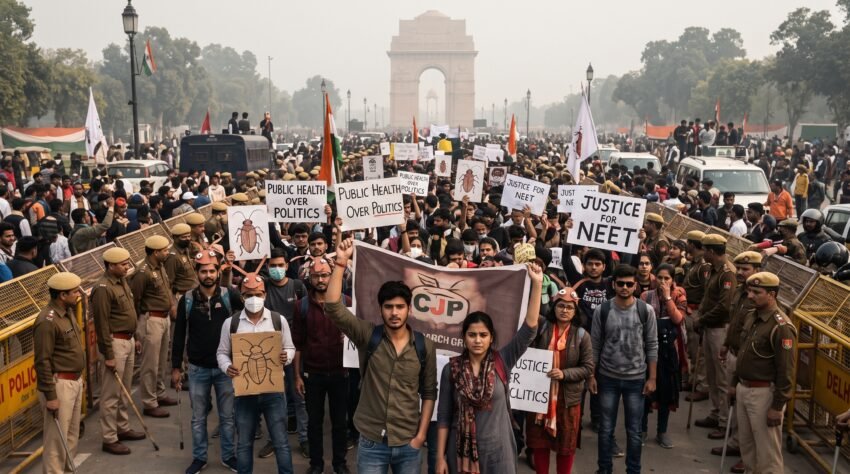
In October 2026, New Delhi’s streets look like a fortress. The Cockroach Janta Party, or CJP, started as a satirical youth movement. It grew into a political force, energizing millions of young Indians against the BJP.
What began as pushback against unemployment and a remark by the Chief Justice has escalated. The demonstrations reflect broader public discontent across cities. India’s “Cockroach” Uprising: Why the CJP Protests Are a Public Health Crisis in Disguise has shaped the discussion.
Beneath the mass detentions and politics lies a neglected health issue. India is facing a compounding public health emergency.
The intersection of the CJP protests and the BJP’s state response is clearer than it seems.
Moreover, India’s “Cockroach” Uprising: Why the CJP Protests Are a Public Health Crisis in Disguise highlights broader health concerns.
When we analyze the root causes and consequences, three major public health threats emerge.
1. The NEET Leaks and the Threat to Medical Integrity
The NEET Leaks and the Threat to Medical Integrity
The CJP’s meteoric rise was fueled by governance failures, notably leaks in NEET. NEET is the sole gateway for undergraduate medical education in India. When this exam is compromised, it is not merely an administrative scandal. It is a direct threat to India’s public health infrastructure. India relies on a steady, merit-based influx of medical professionals to serve its massive population. This reality underscores India’s “Cockroach” Uprising: Why the CJP Protests Are a Public Health Crisis in Disguise.
2. The Mental Health Epidemic of the “Unemployed”
The CJP explicitly highlights the crisis of youth unemployment. It famously lists being ‘unemployed (by force, by choice, or by principle)’ as a satirical eligibility criterion for joining. Chronic unemployment is a well-documented social determinant of health. When millions of young people are jobless, the state response is heavy-handed. It includes the alleged detention of over 10,000 protesters and severe city restrictions. Public transport shutdowns, like the Delhi Metro, amplify the impact. Moreover, this generation grapples with anxiety, depression, and hopelessness, worsened when authorities crack down instead of engaging in dialogue. This topic is titled India’s “Cockroach” Uprising: Why the CJP Protests Are a Public Health Crisis in Disguise.
3. Misplaced State Priorities and Chronic Health Crises
The state is shutting down capital infrastructure, restricting cab services, and detaining districts to manage the CJP protests. India’s actual, lethal public health emergencies remain under-addressed.
Additionally, air pollution alone causes over 2.1 million early deaths annually in India. It also I’m…
When a government must expend massive resources on suppressing youth dissent, it strains public services. Moreover, deploying police across state borders, checking hotels, and blocking internet communication diverts funding from life-saving public health interventions.
Additionally, a distracted state cannot effectively combat pollution, malnutrition, or underfunded rural clinics. Its attention is pulled away from essential reforms that protect communities. This neglect harms health outcomes and widens inequalities. Communities suffer longer wait times, reduced vaccinations, and fewer preventive care options as a result.
The global community watches how the world’s largest democracy handles a new generation of digital-native protesters. Moreover, they use humor and non-violence to challenge the status quo. True public health extends far beyond hospitals and clinics. It encompasses the social, economic, and psychological well-being of an entire population. Until the systemic grievances raised by the CJP—educational integrity, employment, and democratic transparency—are addressed. India’s broader public health will remain structurally compromised.