
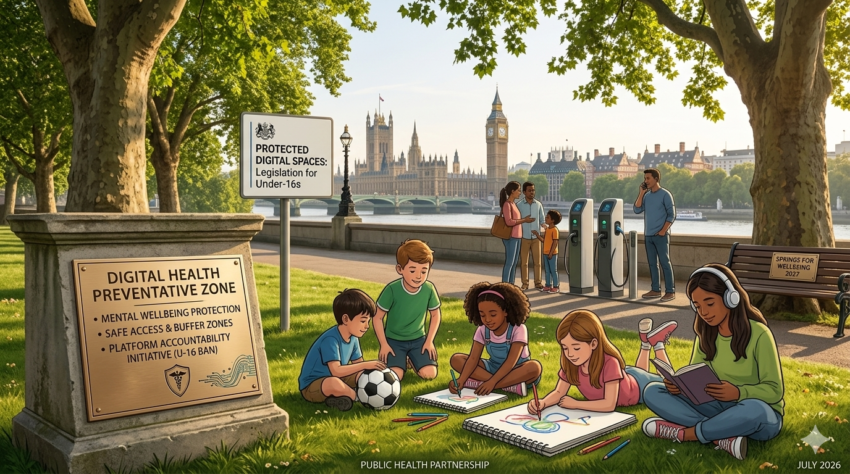
In the modern era, public health is no longer just about clean water, vaccines, and physical safety. Today, some of the most pressing threats to wellbeing happen behind a glowing screen.
The UK Government has confirmed groundbreaking, UK-wide plans to implement a social media ban for under-16s. This isn’t just a political shift; it is a massive intervention in digital public health designed to tackle an escalating mental health crisis among youth.
Here is a breakdown of what is changing, why it matters, and how it reframes the relationship between youth wellness and Big Tech.
What’s Changing? The Anatomy of the Ban
According to the details, the upcoming legislation is comprehensive, targeting the most addictive spaces on the internet while maintaining essential communication channels.
- A Full Ban on Major Platforms: Under-16s will be completely blocked from major algorithmic and content-heavy networks, including TikTok, Instagram, Snapchat, YouTube, Facebook, and X.
- Communication Remains Open: Recognizing that digital connection isn’t inherently bad, messaging apps like WhatsApp and Signal are explicitly excluded from the ban, allowing teens to keep in touch with peers and family.
- Targeting the Tech Giants, Not the Kids: Crucially, the burden of enforcement falls on tech companies, not the children. Platforms will be held legally and financially responsible for keeping underage users off their sites.
- The Timeline: Legislation is aimed for rollout before Christmas 2026, with the full ban expected to be actively in force by Spring 2027.
Beyond the blanket ban, the government is also introducing default blocks on livestreaming, stranger chats, and interactive gaming features for under-16s. Furthermore, they are exploring future rules for 16-17-year-olds, including overnight curfews and enforced breaks in infinite scrolling.
The Public Health Perspective: Why This Matters
For years, psychologists, pediatricians, and public health officials have raised the alarm about the correlation between heavy social media use and skyrocketing rates of youth anxiety, depression, and body dysmorphia. By treating social media access as a public health issue—similar to age restrictions on alcohol or tobacco—this policy shifts the narrative in three critical ways:
1. Combating the “Infinite Scroll” and Sleep Deprivation
Features like infinite scrolling and hyper-personalized algorithms are engineered to keep brains hooked by triggering intermittent dopamine hits. For a developing brain, this can decimate attention spans and disrupt crucial sleep cycles. The proposed restrictions—and potential overnight curfews for older teens—are direct interventions to protect adolescent brain development and sleep hygiene.
2. Eliminating Digital Exploitation and Cyberbullying
By implementing default blocks on livestreaming and stranger chats, the policy directly mitigates severe public health risks like online grooming, cyberbullying, and exposure to harmful content. It creates a digital “buffer zone” during a child’s most vulnerable developmental years.
3. Lifting the Burden from Parents
Until now, managing a child’s digital footprint was treated as an individual parenting failure if things went wrong. However, parents have been fighting a losing battle against multi-billion-dollar algorithms designed by the world’s smartest software engineers. By holding the platforms responsible, the government establishes a regulatory safety net, ensuring that child safety is built into the digital environment by default.
Moving Forward: A Healthier Digital Future
The UK’s proposed timeline means that by Spring 2027, the digital landscape for teenagers will look drastically different. While critics will undoubtedly debate the enforcement feasibility and freedom of expression, from a preventive health standpoint, this policy is a monumental step.
Physical playgrounds have safety standards, guardrails, and soft flooring to protect children from harm. It is about time our digital playgrounds have the same.
Test, message – Thank you!